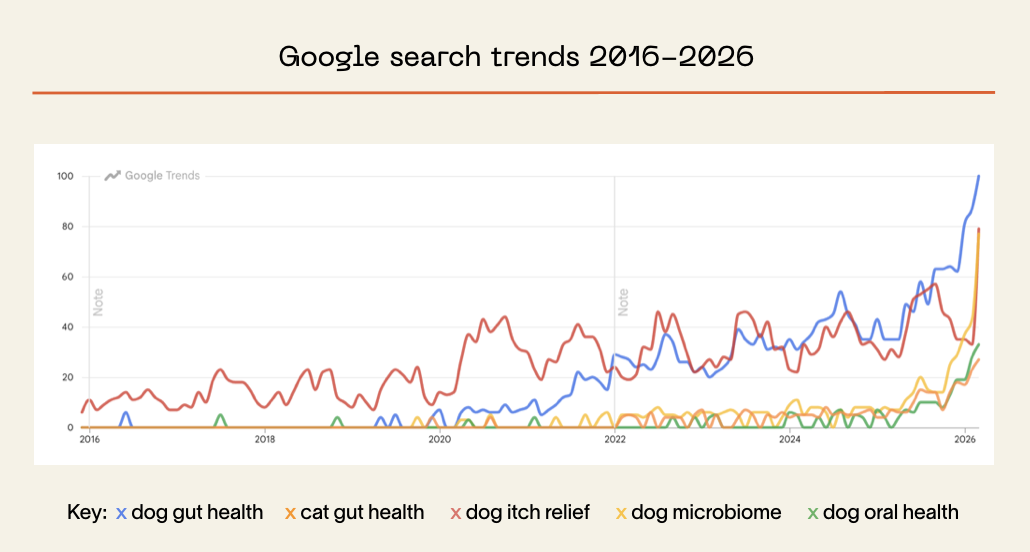
Earlier this summer, we identified cat ownership as one of five forces reshaping pet health. From 2019 to 2025, the ratio of kitten-owning to puppy-owning households climbed from roughly 66% to 99%. Cat-owning households grew while dog-owning households declined, bringing the ratio close to one-to-one (Packaged Facts).
Products built for cats are lagging
Cat parents are becoming more active supplement users. Vitamin and supplement use among cat parents rose from 20% in 2018 to 34% in 2024 (GlobalPETS).
Even so, cats remain underserved. Cat parents account for only about 21% of pet supplement sales, compared with 77% for dog parents (Packaged Facts). That gap does not reflect a lack of interest in feline health. 72% of cat parents seek products that improve health and wellness (Packaged Facts), and sales of functional natural cat food grew 15% from 2019 to 2023, compared with 10% growth across the overall cat food market (OC&C, reported by Petfood Industry).
Digestive health stands out
Nearly half of cat parents (46%) are looking to food for gut or digestive-health benefits (Petfood Industry), while gastrointestinal upset is a leading reason cats visit the veterinarian (Nationwide Insurance).
Our clinical research at Kingdom reinforces the gut-health opportunity for cats. In a randomized, double-blind, placebo-controlled study in cats, our Superculture® Pet Immune ingredient significantly improved stool quality after 28 days compared with placebo. It also decreased the abundance of Streptococcus, a bacterial genus associated with feline dysbiosis and diarrhea.
Digestive health is one part of a broader set of feline priorities. Hairballs, urinary health, and hydration are particularly prominent in cats. Oral health, healthy weight, emotional wellbeing, and healthy aging also represent substantial needs:
- Banfield reported that 64% of cats seen at its hospitals in 2023 received a dental-related diagnosis.
- More than half of cats examined by veterinarians are reportedly overweight or obese (Petfood Industry).
- More than half of cat-owning households include a cat over age seven, and more than one-third report feline anxiety (Packaged Facts).
Form factors are diversifying
Cat parent purchasing of mixers and toppers more than doubled from 8% in 2018 to 19% in 2024. Wet-treat purchasing increased from 18% in 2022 to 25% in 2024. (American Pet Products Association, 2025 Dog and Cat Report)
We saw the same shift at SuperZoo 2026, where toppers, broths, lickable treats, pillow treats, powders, and other feline-friendly formats featured prominently across the show floor and new product showcase.
Formulation and form factor are especially important. Cats are highly sensitive to taste, smell, and texture, so products and the ingredients they are formulated with must be palatable at the intended dose, stable throughout processing and storage, and convenient enough to use consistently.
The bottom line
Cat ownership, and demand for functional products, is growing quickly, but the right approach to meet this demand will not come from adapting what works for dogs into smaller serving sizes. The products that succeed will be developed around feline biology, supported by feline clinical evidence, and delivered in form factors that easily integrate into a cat parent’s daily routine.
At Kingdom, we are investing heavily in feline clinical research across several cat-specific health needs through multiple placebo-controlled studies of our ingredients. If you are developing products for the growing feline health market, get in touch with our team.