Living and working in Brooklyn, NY, I am forever indebted to the brilliant minds behind the humble HVAC system. It keeps me cool and dry on the sweltering 90% humidity, 90ºF summer days, and warm and cozy in the freezing winter months. Complete with a few carefully curated snacks, and I have the perfect conditions to do my best work building the manufacturing processes behind our Superculture® ingredients.
Remarkably, the microorganisms that make our Superculture® ingredients are not that different. Given the right environmental conditions and the right snacks, they will happily generate the beneficial compounds that set our ingredients apart, and my team and I work hard to figure out what they like and how to give it to them so that they, too, can produce their best work (that is, our Superculture® ingredients, of course!)
The microbial equivalent of an office building with a functional HVAC system and good food options is a finely tuned bioreactor. It provides the sterile environment to grow, feed, and pamper the microorganisms that ferment raw materials into our Superculture® ingredients. If you’ve consumed beer, wine, or vinegar (among many other things!), you’ve already consumed products generated in bioreactors. You may even have seen them at a microbrewery near you. They are these large stainless steel tanks with all sorts of pipes, bells, and whistles attached to them.
Depending on how much pampering an organism needs to provide the fermentation you want, bioreactors can be more or less complex. Simple vats have been used for thousands of years to ferment barley and grapes into beer and wine, but modern engineering has led to extremely refined ways to control a fermentation environment, and we exploit these technologies to ferment new innovative ingredients that could not be fermented before. In the modern bioreactor, physical and chemical parameters are tightly controlled, giving us the ability to precisely reproduce a process from batch to batch, and to set the right parameters at the right time so that the microorganisms consistently produce efficacious Superculture® ingredients.
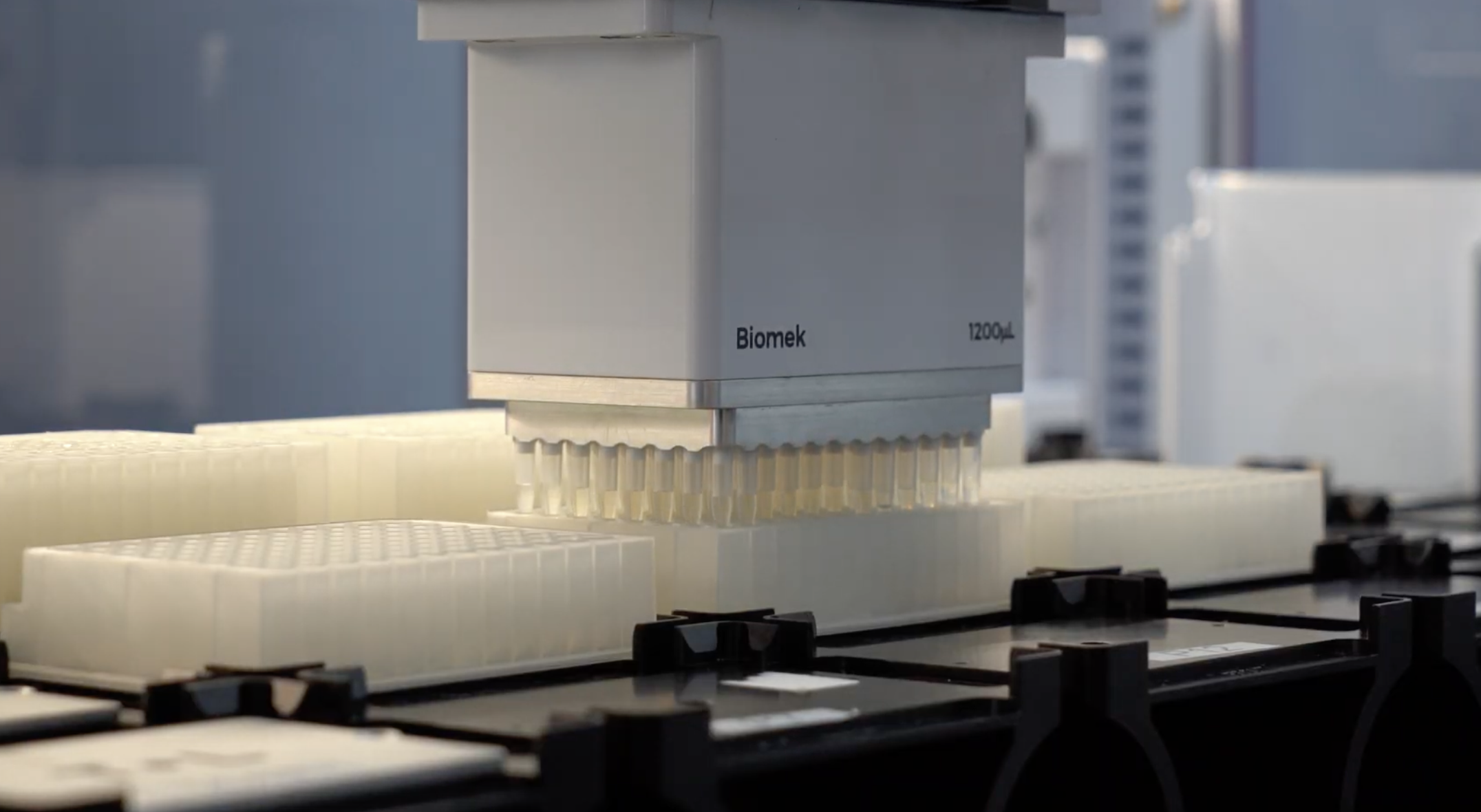
Bioreactors can precisely control a microorganism’s environment, but how exactly do we define what that environment should be? Simple: we try and see what it likes! Jonna explained in her blog post the work done in microtiter plates to test the myriad of ways one can make a microorganism happy, but microtiter plates contain a few milliliters (0.03 oz), whereas manufacturing bioreactors are thousands of gallons with vastly different fluid dynamics and controls, so how do we bridge that gap and know that our organisms will like it in there, too? Thankfully, another modern miracle solves that problem: the benchtop bioreactor. Usually sized between a pint and a gallon, these small reactors can be lined up on a lab’s bench while providing the same functionalities and process control capabilities as their larger production counterparts. They are the right in-between: small enough to test a meaningful number of processes in parallel, and large enough to allow controls similar to manufacturing bioreactors.
Hence, to generate the processes that generate our Superculture® ingredients, we move progressively from small volumes with little control to large volumes with precise control, increasing our understanding of the microorganism’s preferences at every step. That is commonly referred to as the “scale-up chain”: we start from thousands of roughly optimized fermentation reactions during screening (see Anthony’s post) and narrow it down to one extremely optimized and reproducible reaction in production bioreactors.
The fun does not stop with the fermentation, though. Most fermentations happen in liquid state, but our final ingredients are shelf-stable powders, so how do we get from one to the other? The steps after fermentation sit under the “downstream processing” umbrella, and it generally ends with drying. At Kingdom, we are big fans of spray drying, which allows us to quickly remove thousands of liters of water without causing too much heat exposure, so that our ingredients maintain their efficacy while being stable and flowable powders. Just like fermentation processes, downstream processes also need to be optimized, and in our next blog post, Maya will tell you more about how we run process optimization in benchtop reactors and spray dryers.